Burning Spear
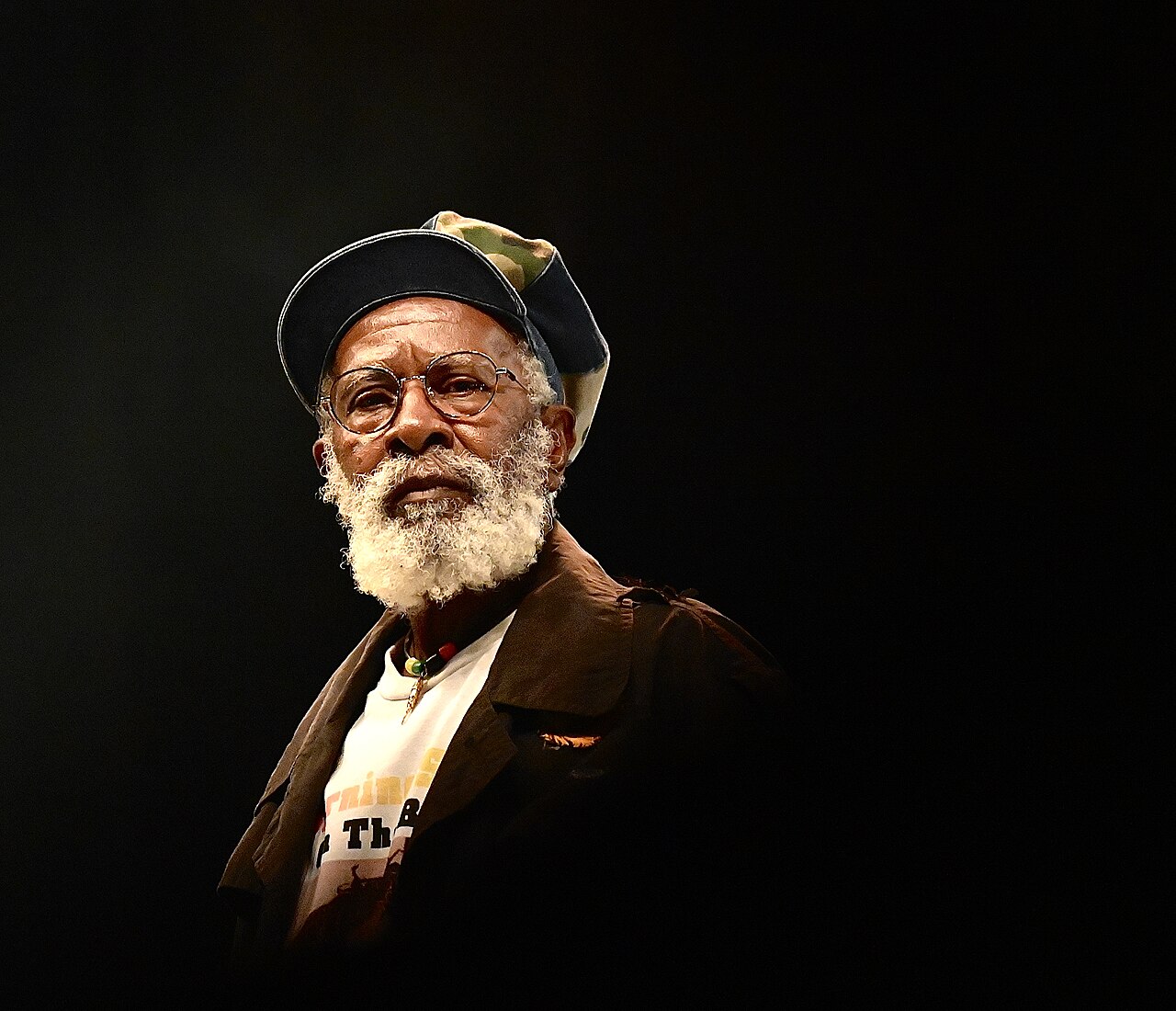
The Boy From St. Ann Who Met Bob Marley
Winston Hubert McIntyre Rodney was born on March 1, 1948, in the parish of St. Ann, Jamaica — the same parish that produced Bob Marley, and the same parish that Marcus Garvey called home. Whether that was coincidence or destiny is a question Burning Spear himself might say was never really a question at all.
Growing up in the rural hills of St. Ann, Rodney was shaped by the land, by the community, and by a deep awareness of Jamaican history that most of his contemporaries were not yet ready to fully reckon with. It was Bob Marley himself who first encouraged the young Rodney to pursue music professionally, pointing him in the direction of Studio One — the legendary Kingston label run by Clement 'Coxsone' Dodd — where his recording career would begin.
He took the name Burning Spear from Kenyan independence leader Jomo Kenyatta, who had been known by that name. The choice was deliberate and revealing: this was not a man building a pop career. This was a man with a mission.
Studio One And The Birth Of A Sound
Burning Spear recorded his first singles at Studio One in the early 1970s, releasing tracks including Door Peep and Joe Frazier (He Prayed). Even in these early recordings, the hallmarks of what would become his signature sound were already present — the slow, meditative rhythm, the voice that seemed to rise from somewhere deep and ancient, and lyrics that looked outward at history and inward at conscience simultaneously.
He recorded at Studio One with a shifting group of vocalists, but it was when he formed a trio with Rupert Willington and Delroy Hines — collectively billed as Burning Spear — that the recordings began to truly capture something extraordinary. The combination of voices, with Rodney's deep lead anchored by the harmonies around him, created a sound that felt less like a pop group and more like a congregation.
These were not love songs. They were not dance records. They were calls to memory — reminders to a people of where they had come from, what had been done to them, and what they owed to their own history.
I am not a politician. I am not fighting for a position. I am fighting for the people, for the truth, for what is right. — Winston Rodney (Burning Spear)
Marcus Garvey: The Album That Changed Everything
In 1975, Burning Spear released Marcus Garvey on Island Records — and with it, he changed the conversation about what reggae music could be. The album was a direct and unflinching tribute to Marcus Mosiah Garvey, the Jamaican political leader and Black nationalist whose message of Pan-Africanism, self-reliance, and repatriation had been largely ignored by mainstream history. Burning Spear was not willing to let that stand.
The title track opens the album with one of the most striking declarations in all of reggae — slow, heavy, and utterly certain of itself. It is not a protest song in the conventional sense. It is something older and more serious than that: a lament, a prophecy confirmed, a reckoning.
Its companion piece, Garvey's Ghost, released the same year, stripped the tracks back to dub — turning the already sparse, heavy originals into pure atmosphere and rhythm. Together, the two albums represent one of the most complete artistic statements in reggae's history.
Rolling Stone magazine later placed Marcus Garvey on its list of the 500 Greatest Albums of All Time. More importantly, the album introduced a generation of listeners — in Jamaica, in the UK, in North America, and across Africa — to Marcus Garvey himself. For many of them, it was their first encounter with his ideas. That is the power of music used with intention.
A Career Built On Conviction, Not Compromise
What followed Marcus Garvey was one of the most consistent and uncompromising discographies in the history of popular music. Where other artists adjusted their sound to chase trends, Burning Spear deepened his. Each album was an extension of the same mission — to remember, to educate, to resist, and to connect the present to the past.
Dry & Heavy (1977) pushed further into dub and roots territory. Hail H.I.M. (1980) was a powerful Rastafarian statement released at the height of reggae's international moment. And throughout the 1980s and 1990s — a period when reggae's commercial centre shifted dramatically toward dancehall — Burning Spear simply continued. He toured relentlessly, recorded continuously, and never once suggested that the message had an expiry date.
He established his own label, Burning Music Productions, giving himself full control over his work and his legacy. That independence — creative, financial, philosophical — is itself a statement entirely consistent with everything Marcus Garvey ever taught about self-reliance.
A Career Built On Conviction, Not Compromise
The music industry eventually caught up with what Burning Spear's audience had known for decades. He has won multiple Grammy Awards for Best Reggae Album — including wins for Jah Kingdom (1991) and Calling Rastafari (2000) — and has received nominations spanning four decades of recording. In 2018, he was awarded the Order of Distinction by the Jamaican government, one of the country's highest civilian honours.
But perhaps the most telling recognition came not from any institution, but from the artists who came after him. Burning Spear's influence runs through decades of conscious reggae — through the music of Sizzla, Capleton, and Luciano, through the work of artists in Africa, Brazil, and Japan who found in his records a language for their own histories and their own resistances. When musicians say they want to make music that matters, Burning Spear is often what they mean.
Still Burning
Now in his late seventies, Winston Rodney has not stopped. He has continued to record and perform into the 2020s, carrying the same conviction he has carried since the early sessions at Studio One. The fire has not dimmed. If anything, the passage of time has given it a different quality — something closer to grief, perhaps, for the things that have not changed; but also something closer to wisdom about why it matters to keep saying them anyway.
He remains one of the last living links to reggae's foundational generation — the artists who built the music from the ground up in Kingston in the 1960s and 1970s and gave it both its sound and its conscience. When Burning Spear performs, you are not just watching a concert. You are watching the continuation of something that began long before the music started and will continue long after the last note fades.
We believe that understanding Burning Spear is essential to understanding reggae — not just as music, but as a movement, a philosophy, and a way of insisting that history belongs to the people who lived it. His records are not archived documents. They are living things. Put one of his Albums on today, and you will understand immediately what we mean.